Great weather again! Today we are headed to the Fløibanen Funicular, which departs about 200 yards from the Fisketorget and climbs 1000 feet in seven minutes to the top of Mt. Fløyen for a commanding view of the city of Bergen. Two Fløibanen cars run in alternate directions precisely timed to pass each other on a section of double track halfway up a steep hillside every 15 minutes.


From the spectacular viewing platform 1000 feet above Bergen, you can see Vågen bay, the Nordnes peninsula, the island of Askøy and all the way to the Norwegian Sea. The top of Mt. Fløyen is the starting point for many hikes--ask the ticket office for the guide with 10 routes around Mt. Fløyen. At the end of the day, Mt. Fløyen offers a great vantage point for sunsets from the Fløien Folkerestaurant at the top. However, we were told that for many days of the year, the view from Mt. Fløyen is foggy or in the clouds. You can monitor the view from the Mt. Fløyen webcam.

 |
| The Fish Market is located at the end of the green steeple |


After enjoying this wonderful elevated view of Bergen, we took one of the hiking paths and wandered through vegetation that was strikingly similar to the ferns and conifers we commomly see in Canaan Valley, WV. On a clear day, the local populace also flocks to Mt. Fløyen for hiking, picnics and feeding the unique red squirrels.
 |
| Identical vegetation to that seen in Canaan Valley! |


Following our descent from Mt. Fløyen, we headed back to the hotel to check on Linda who was trying to shake a respiratory virus she picked up earlier on the trip. The Hotel Havnekontoret was a shipping headquarters dating back to the 1920's. Hotel guests are permitted to obtain a key and climb it's historic watch tower to enjoy a great view of the city and harbor.
 |
| Watch tower on top of hotel |
 |
| Working movement for the clock in the tower |


Next we visited the Bryygen Museum, located about 3 minutes walk from our hotel. The lower floors of this archeological museum detail the earliest history of Bergen from 1050-1500 AD. The ground floor encloses the remains of actual wooden tenements in their original arrangement and location dating from the 12th C. In addition to remains of a 100 ft long wooden ship found on site, there are various artifacts that detail life in medieval Bryygen. Even today there is universal recognition for the purpose of this medieval two-holer...though I must say people must have been smaller and men must had better aim! :)

 |
| The "Beffen" |

 |
| Our Beffen would be crushed like a bug! |
While up on the hotel watch tower, we spotted a tiny little orange ferry boat (the "Beffen") navigating a short route back and forth across the harbor. So, now it was time to ride the Beffen across the harbor and take a walk down the long penninsula of land called the Strandsiden.


The Strandsiden is mostly residential with narrow streets, neat little courtyards and friendly people to strike up a conversation with. One favorite topic was the beautiful weather Bergen had enjoyed these past two days. When we would innocently :)) ask them "isn't the weather like this all the time here?", they would roll their eyes or double over in laughter. We wound our way up the terraces and found ourselves at the highest point on the Strandsiden where we met a young lady from Tromso...why does this sound like the opening line of a bawdy limerick? You may recall Tromso was one of our Hurtigruten ports located several hundred miles north of Bergen where we visited the Artic Cathedral and the Polar Museum. Since we had been there just the previous week, our memories were fresh and we enjoyed a pleasant conversation with her about her hometown versus the city life in Bergen.

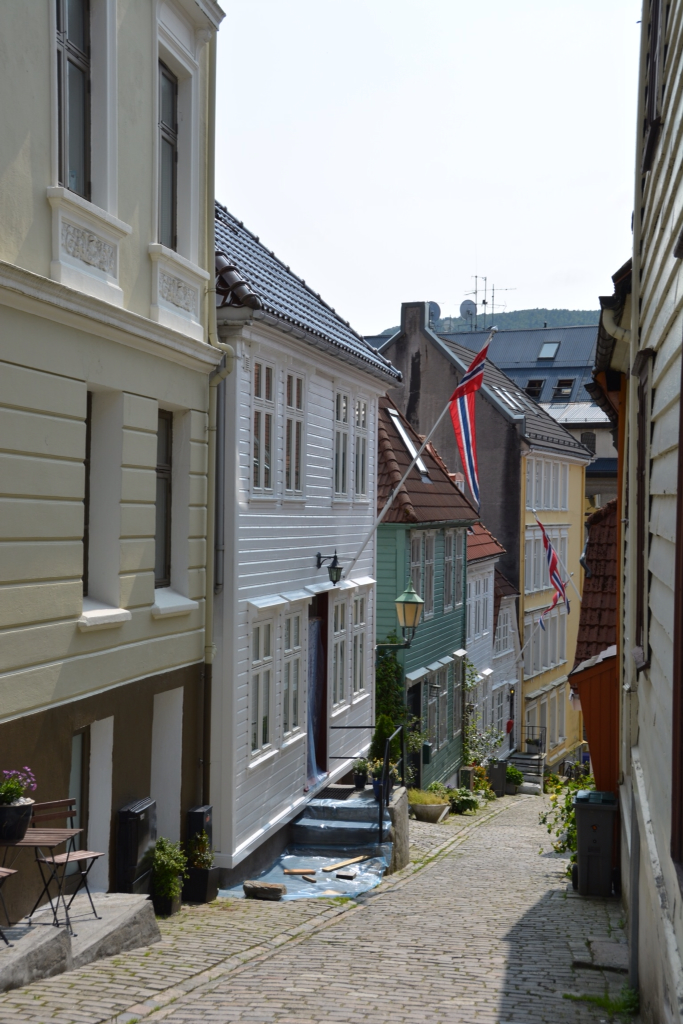
Strolling along, we were treated to the sight of our Hurtigruten ship, the Kong Harald, pulling into the wharf having retraced the route southbound and back to Bergen. By this time, the ladies were ready to head back to the hotel. However, Manfred and I felt compelled to hang out at a cafe in the theatre district and people watch.

 |
| This guy plays bottles with varying levels of water! |
Finally, it was time to join the ladies for dinner on our last evening in Bergen. Tomorrow will be a long day with a flight first to Iceland, then back to the USA!

 Posted by TBW Travel Today!